Security, Privacy & Compliance
How do you handle Personally Identifiable Information (PII) during document and audio collection?
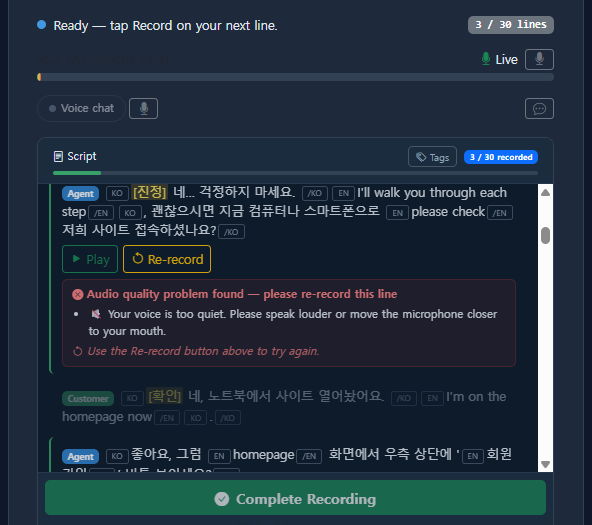
WiseData scopes PII handling before collection, applies project-specific consent and access rules, and uses redaction workflows for documents, transcripts, and recordings when required. Participants and reviewers work in our controlled, in-browser workspace so source media is not distributed as ordinary files. We can configure retention, deletion, and audit procedures to support GDPR, CCPA, and customer-specific privacy requirements. No downloads, no data leakage.
Is client data downloaded by your annotators or stored on local devices?
No. Annotators access assigned media through the Secured Annotation Workspace, where document, image, audio, and video tasks are completed in-browser. Access is restricted by project and role, and the workflow is designed to prevent source files from being downloaded or stored on personal devices. This keeps collection and annotation inside a controlled operating environment.
What security controls are available for enterprise AI data collection?
WiseData uses role-based access, project-scoped task assignment, controlled in-browser media access, supervisor oversight, QA audit trails, and configurable retention and deletion procedures. Security requirements are reviewed during scoping so the operating model, participant access, storage boundaries, and delivery format match the client’s risk and compliance requirements.
Can you collect regulated documents or sensitive speech data?
Yes. WiseData can collect regulated document samples, identity-related documents, financial forms, legal templates, and sensitive speech datasets when the project includes appropriate consent, eligibility, redaction, access, and retention rules. We define the permitted data fields and handling procedure before recruitment begins, then validate compliance throughout collection and QA.
Quality Assurance & Accuracy
How do you guarantee the ≥95% accuracy rate for your AI datasets?
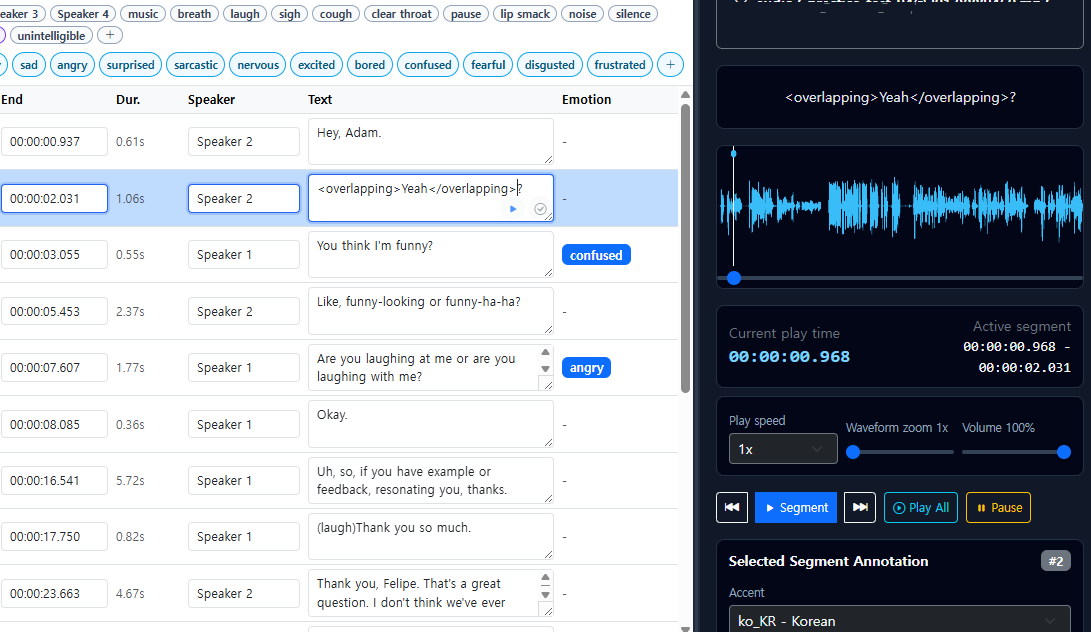
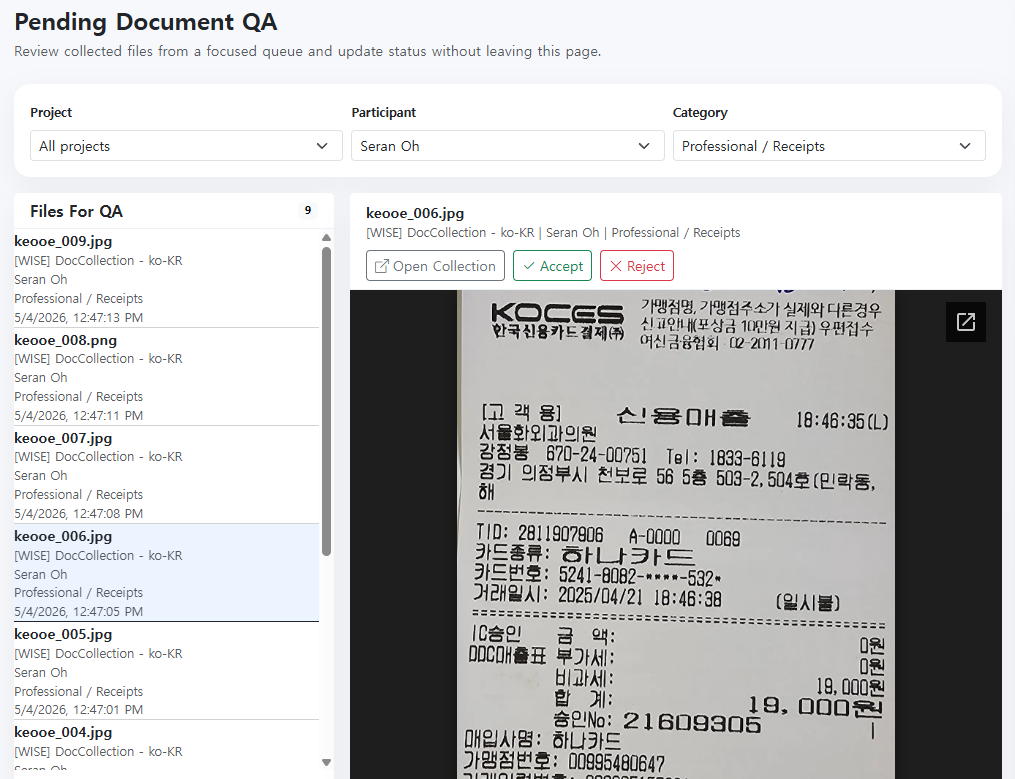
WiseData guarantees ≥95% accuracy through a layered QA pipeline: automated technical validation checks file integrity and required fields; trained reviewers perform human-in-the-loop (HITL) checks with coverage of up to 100% on critical datasets; failed items enter systematic rework cycles; and calibration feedback is fed back into the next collection or annotation batch. Acceptance criteria are agreed during scoping and measured against the delivered dataset.
How do you prevent hallucinations or bias in your multilingual LLM training corpora?
WiseData reduces linguistic and demographic bias through controlled participant recruitment, strict demographic and regional quotas, native-speaker review, locale-specific instructions, and ongoing QA sampling. We track representation across age, gender, accent, geography, and use case where relevant, then re-recruit or rebalance when a batch falls outside the agreed distribution. Native speakers validate cultural meaning, terminology, and naturalness rather than relying only on literal translation.
What quality checks do you perform on speech and audio data?
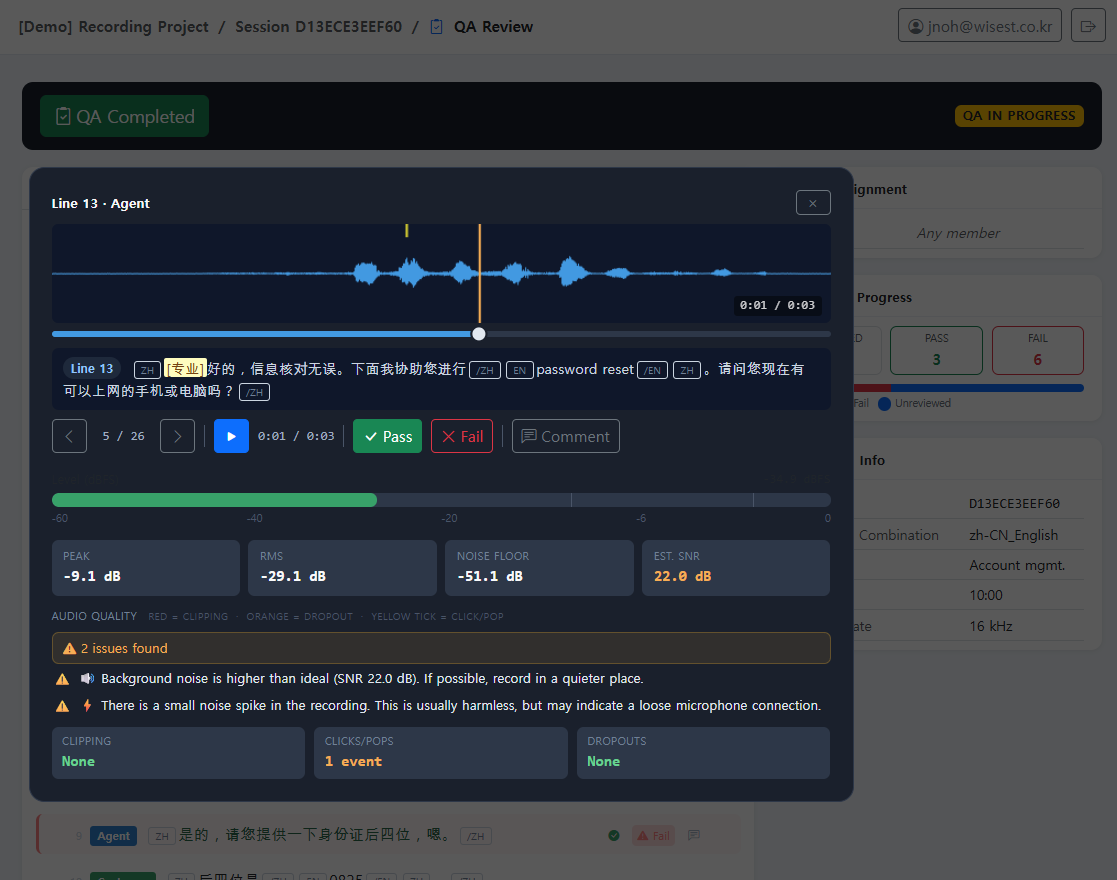
Audio projects can include automated checks for duration, sample rate, channel configuration, clipping, silence, loudness, file format, and required metadata, followed by human review for pronunciation, prompt adherence, transcription accuracy, background noise, speaker eligibility, and naturalness. Failed recordings are rejected or routed into controlled rework before delivery.
How do you measure and report dataset quality?
We define acceptance criteria before launch and report results by batch, locale, modality, and task. Quality reporting can include automated validation pass rates, human review accuracy, error categories, rework rates, quota completion, and unresolved exceptions. Clients receive an auditable view of what passed, what was reworked, and what was excluded from delivery.
Scale, Geography & Specialization
What regions and languages do you specialize in for speech and text data?
WiseData operates across 50+ countries and specializes in high-value Asian languages including Korean, Japanese, Mandarin, Indonesian, Thai, and Vietnamese. We also support global multilingual programs across 50+ languages, with native-speaker recruitment, locale-specific instructions, transcription, translation, utterance collection, and corpus curation.
How do you recruit participants for specialized environments, like AR/VR motion capture or driver monitoring?
WiseData manages specialized projects end to end: we translate technical requirements into participant criteria, recruit and screen eligible participants, schedule sessions, coordinate sites and equipment, supervise capture, and run technical and human QA. For AR/VR, robotics, and driver-monitoring work, our physical logistics cover controlled environments, motion sensors, depth cameras, vehicle setups, lighting, safety procedures, and session-level metadata.
Can you collect data for specific demographics, accents, domains, or environments?
Yes. Recruitment can be configured by age range, gender, region, accent, native language, profession, domain expertise, device, environment, and accessibility requirements. We use screening questions, quota controls, eligibility checks, and supervisor review to keep the collected population aligned with the target model use case.
What types of multimodal AI training data can you collect?
WiseData collects speech and audio, multilingual text and documents, images and video, digital ink and handwriting, human motion, robotics interaction, AR/VR capture, and driver-monitoring data. Projects can combine modalities, for example audio with transcripts and metadata, or video with motion, environment, and annotation layers.
Timelines, Integration & Operations
How long does it take to launch a custom multimodal data collection pilot?
Pilots typically launch within two weeks. The launch path is: scope the modality, languages, quotas, consent, and acceptance criteria; configure the collection and QA platform; recruit and screen participants; run a controlled pilot batch; review results with the client; and then expand to the target volume.
Do you provide real-time visibility into the data collection progress?
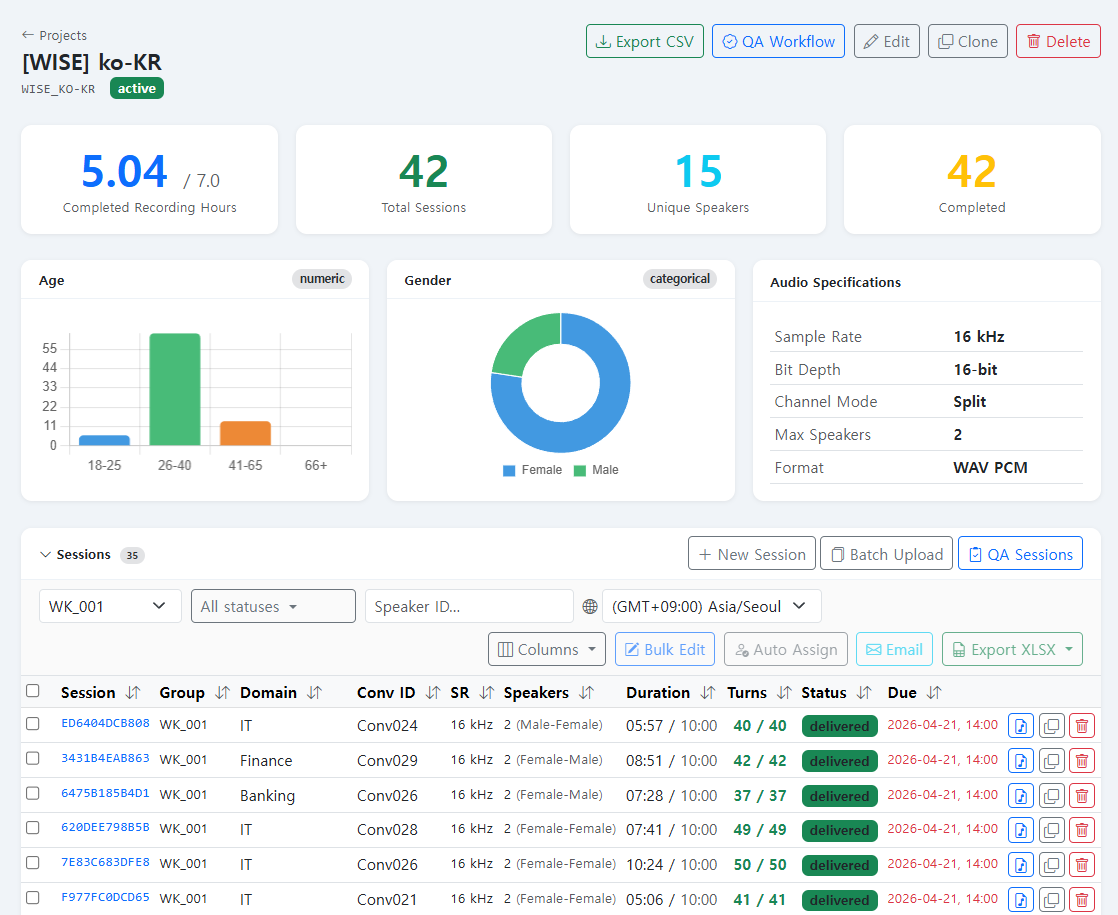
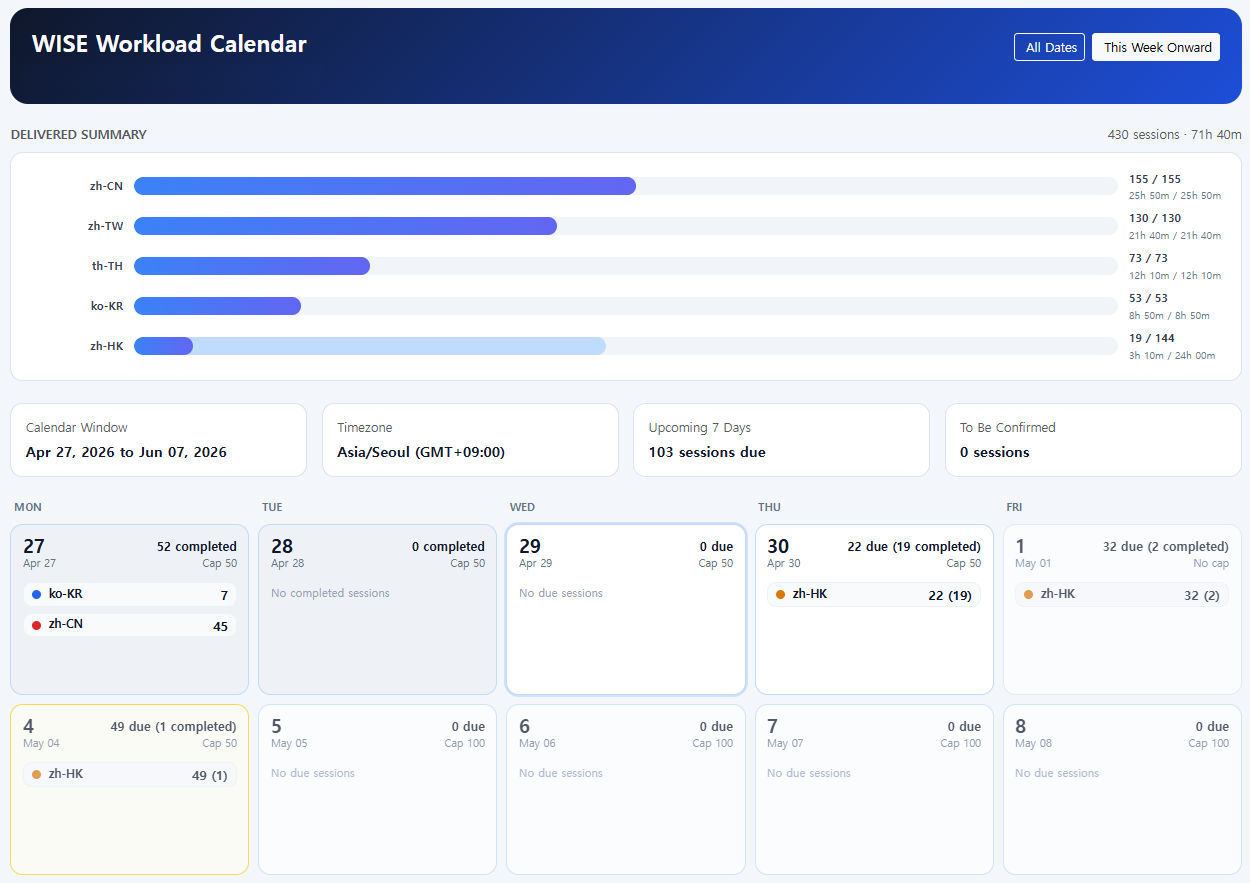
Yes. WiseData provides real-time progress monitoring via a dedicated client dashboard. The OPS Platform and Workload Calendar show session targets, scheduled and completed work, per-language delivery progress, remaining quotas, QA status, schedule gaps, and proactive alerts so Enterprise Data Operations teams can manage delivery without waiting for manual reports.
How do you integrate collected data with an enterprise AI team’s workflow?
We agree the schema, naming convention, metadata, file format, annotation format, validation rules, and delivery cadence during scoping. WiseData then packages accepted data into repeatable batches with QA results and exception reporting, allowing ML Engineers to ingest the output into existing training, evaluation, or data-lake pipelines.
How do you manage changes to requirements during a live project?
The operations team records requirement changes, assesses their effect on recruitment, quotas, schedule, cost, and QA, and confirms the revised acceptance criteria before applying them. The OPS Platform keeps project status and workload planning visible, while supervisors communicate the change to participants and reviewers before the next affected batch.